A dryer vent cleaning kit, and when to book a professional clean
A dryer vent cleaning kit is a fair tool for one kind of house. The duct is short, straight, and metal, and it runs from a ground-floor dryer to a side-wall hood you can see from the yard. It is a poor match for a long run, a roof cap, or a pipe you cannot see the whole way. That is the split between a Saturday project and a job worth booking.
The National Fire Protection Association, using 2010 through 2014 reports, found that failure to clean was the leading factor in home clothes dryer fires, about one-third of them. The same report says long, thin brushes are sold to reach lint in the vent pipe, and that there are also dryer lint removal services. Cleaning the pipe matters. The open question is how much of your pipe a kit actually touches. The figures are in the NFPA report on home fires involving clothes dryers and washing machines.
What is in the kit
Most kits are one of two tools.
A drill-driven rotary brush. Flexible rods screw together. A round brush goes on one end, and the other end chucks into a drill. You feed the brush in from the dryer, or sometimes from the outdoor hood, and you spin it as you push. The brush is meant to scrub lint off the pipe wall so you can vacuum the loose lint out.
A leaf-blower or vacuum attachment. A cone or a hose adapter lets you blow from the dryer toward the hood, or vacuum from the hood back toward the dryer. There is no brush. You are only moving air.
Both are made for a 4-inch duct, which is the usual dryer size. Neither one tells you whether the sections inside the wall are still connected.
What you can safely do yourself
These steps do not need a kit, and they are worth doing before you buy one.
Clean the lint screen every load. Pull it, clear it, and put it back. A full screen is its own restriction. It is not the duct. A clean screen can sit in front of a packed pipe.
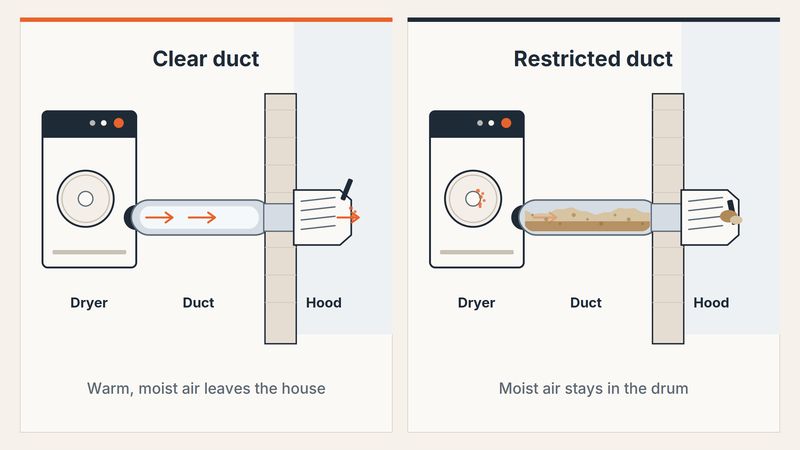
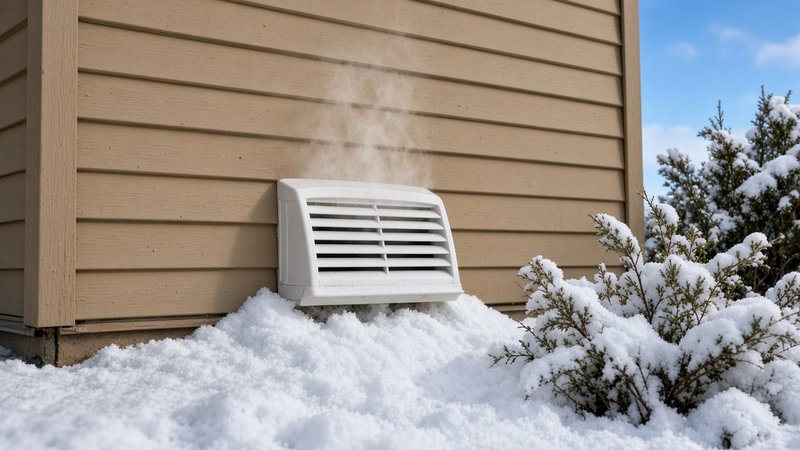
Look at a ground-level hood. With a heated cycle running, the flap or the louvers on a side-wall hood should open, and you should feel warm air a few inches out. Little or no air, with a clean screen, means the restriction is farther in. Stay off the ladder and off the roof for this look. How to check the outdoor hood is the short version of that walk.
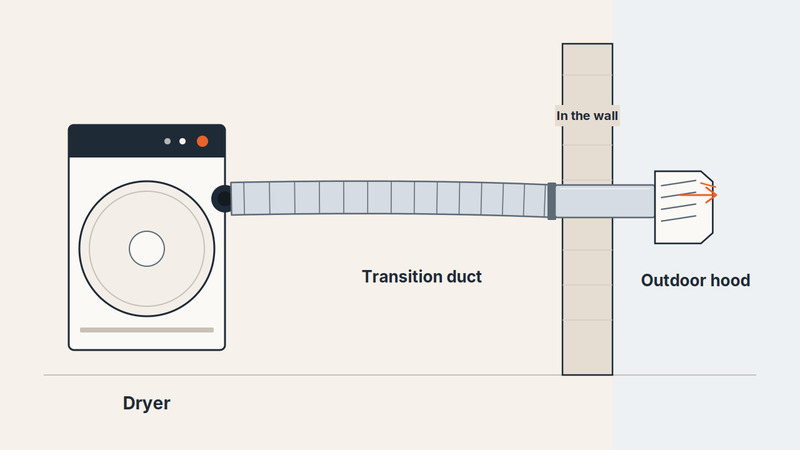
Look at the connector. Slide the dryer out just far enough to see the short piece between the machine and the wall. It should be round the whole way. A flat spot, a kink, or a coil of extra hose is a pinch. On a gas dryer, do not pull, kink, or stretch the gas connector. If you smell gas, stop and leave it alone. Thin foil and vinyl hose crush more easily than a short metal connector. That piece is covered in the duct behind the dryer.
Brush a short, straight metal run, if you can see both ends. The outdoor hood should be a ground-floor or first-floor side wall. The duct should be smooth metal and still round. Disconnect the dryer end, keep a vacuum at the opening you are working from, and stop when you can tell the brush is near the hood. When you finish, put the connector back on with a metal clamp, not tape, and run a cycle. The flap should open, and the air should feel stronger than it did before.
If any of that is missing, stop. Forcing the brush is how a kit gets left inside the duct.
What the brush can reach
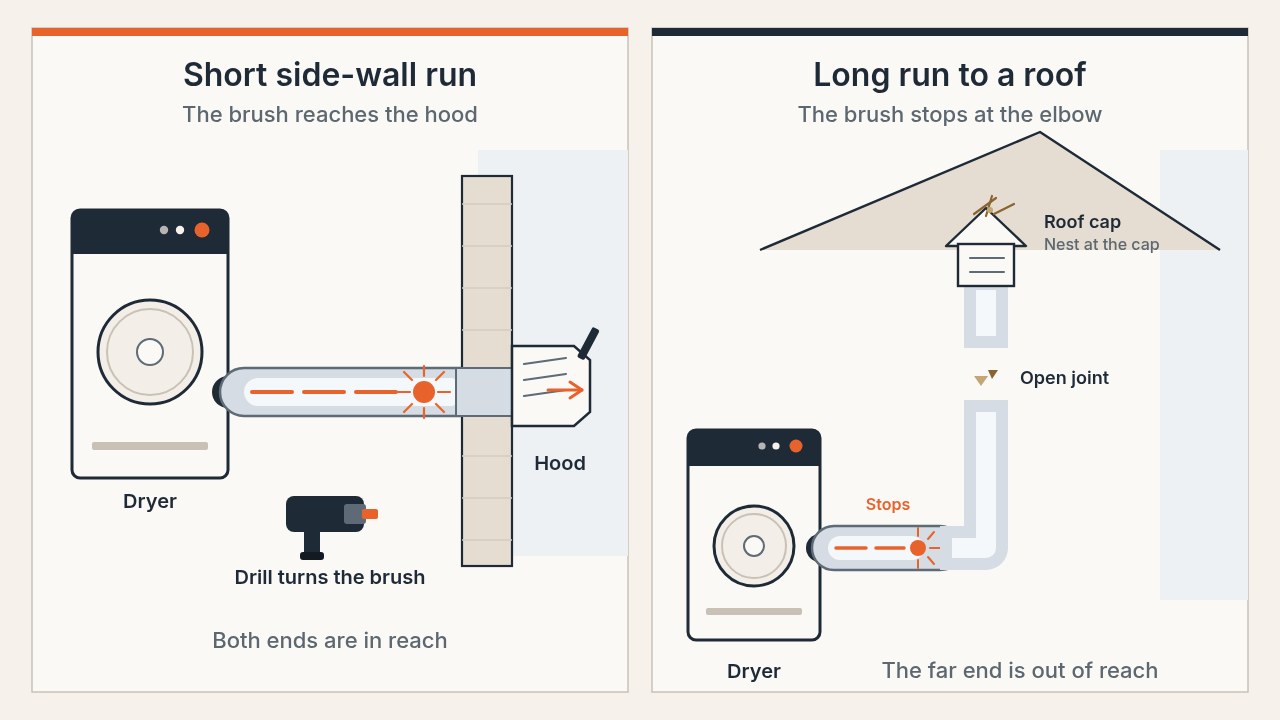
A round brush follows a round pipe. On a short side-wall run, often under about 15 feet and with no more than one gentle turn, the brush can scrub most of the length. You can tell, because lint shows up at the hood or in the vacuum, and the air at the flap picks up.
That is the job the kit is built for. A ground-floor laundry room on an outside wall is often exactly that.
What a kit does not clear
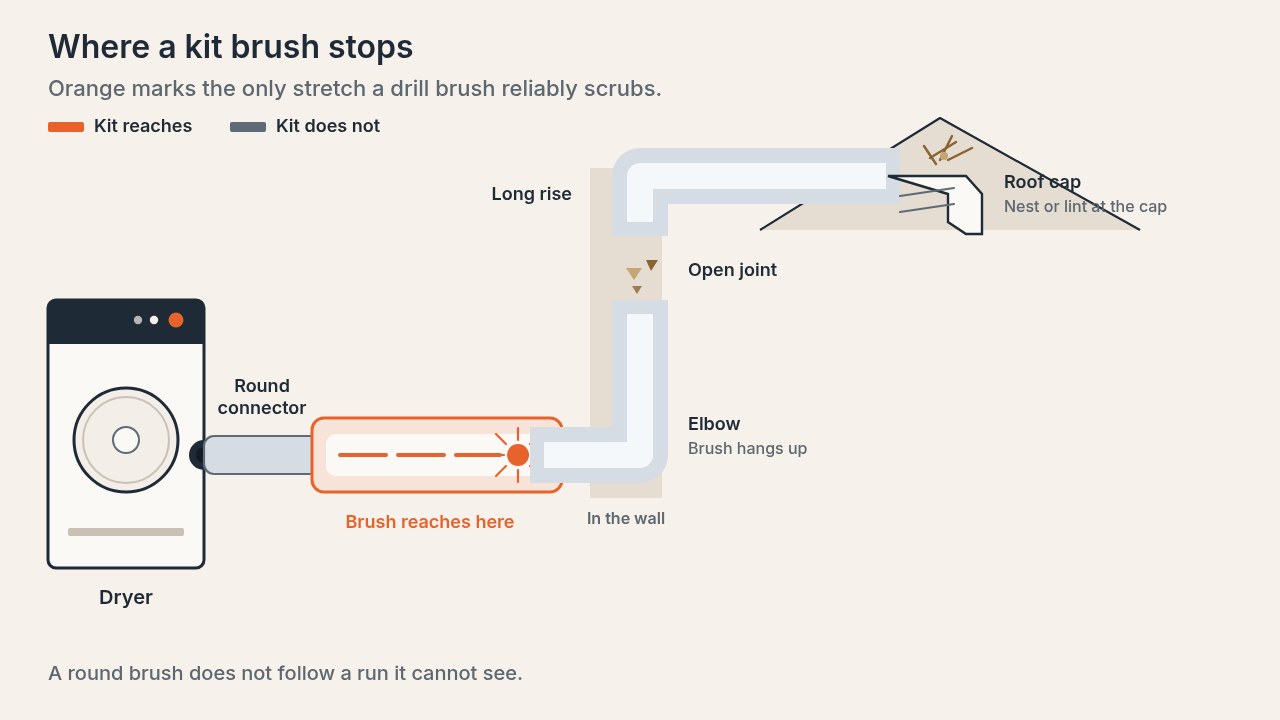
Long runs and elbows. Each bend is a place the brush hangs up. The rods flex, the brush rides the inside of the turn, and lint on the outside of the bend stays put. A laundry room in the middle of the house, or a duct that climbs, has more pipe and more turns than a dryer on an outside wall. Past roughly 15 feet, or more than a couple of elbows, you are guessing about the far end.
Roof terminations. Some homes exit through a roof cap or a high wall instead of a side-wall hood. You often cannot see that cap from the ground, and you should not climb up to push a brush into it. Feeding the brush from the laundry room usually stops at the last elbow before the roof. The cap, where lint and debris sit, never gets touched.
A crushed transition duct. A round brush does not pass a hose that has been flattened behind the dryer. The problem is the shape of the pipe, not a plug of lint a brush can scrub out. Replacing that connector is a separate job, and only when you can reach both ends without disturbing a gas line.
Bird nests. A hood with a missing or stuck flap can let a bird in. The U.S. Fire Administration notes that a dryer exhaust can also be blocked by nests of small birds or other animals, not only by lint. A nest is twigs and debris. A spinning brush jams in it. The hood or the cap has to come off. That note is in the USFA report on clothes dryer fires in residential buildings.
A brush that sticks. The brush is a threaded fitting on a flexible rod. It can unscrew inside the duct, or catch on a screw, a rib, or a nest. If the brush stops, do not add force. Reverse the drill slowly and pull straight back. If it will not come out, stop. Do not run the dryer with a brush or a rod still inside. That is a blocked duct with a metal head in it.
A joint that has come apart. Sections in a wall or an attic are held by clamps, or by tape that has dried out. If a joint has separated, the brush can leave the pipe and spin in the cavity. From the laundry room it can feel as if the brush suddenly got easy. Air and lint then go into the wall, not outdoors. A kit cannot show you that gap. You notice only when the brush comes back dirty in the wrong place, or does not come back.
Blowers and vacuum attachments
A leaf blower aimed into the dryer end can move a loose bit of lint. It can also pack a wad tighter against an elbow or a closed flap, and it can blow lint out of a loose joint into the laundry room or the wall. If the outdoor flap is stuck shut, the air comes back at you.
A vacuum at the hood only pulls what is already near the opening. Lint coating a long pipe, or sitting in an elbow you cannot see, stays there. Neither attachment shows you a crushed connector, a nest at a roof cap, or a joint that has pulled apart.
Use a vacuum to catch lint while you brush a short run you can see. Do not treat a blower as a way to clean the whole duct.
Boulder County houses
The climate here is dry. That does not keep a duct clear. Lint is light, and it still settles where the air slows down: in an elbow, in a sag, and at the hood.
Two-story houses and townhomes in the county often put the laundry upstairs or toward the middle of the plan. The duct then climbs to a roof cap, or it runs a long way to a side wall. A kit sold for a short, straight vent does not follow that path. The price follows the vent, not the street. How to tell a short side-wall run from a roof or long run is in roof versus ground.
When the professional clean is the better job
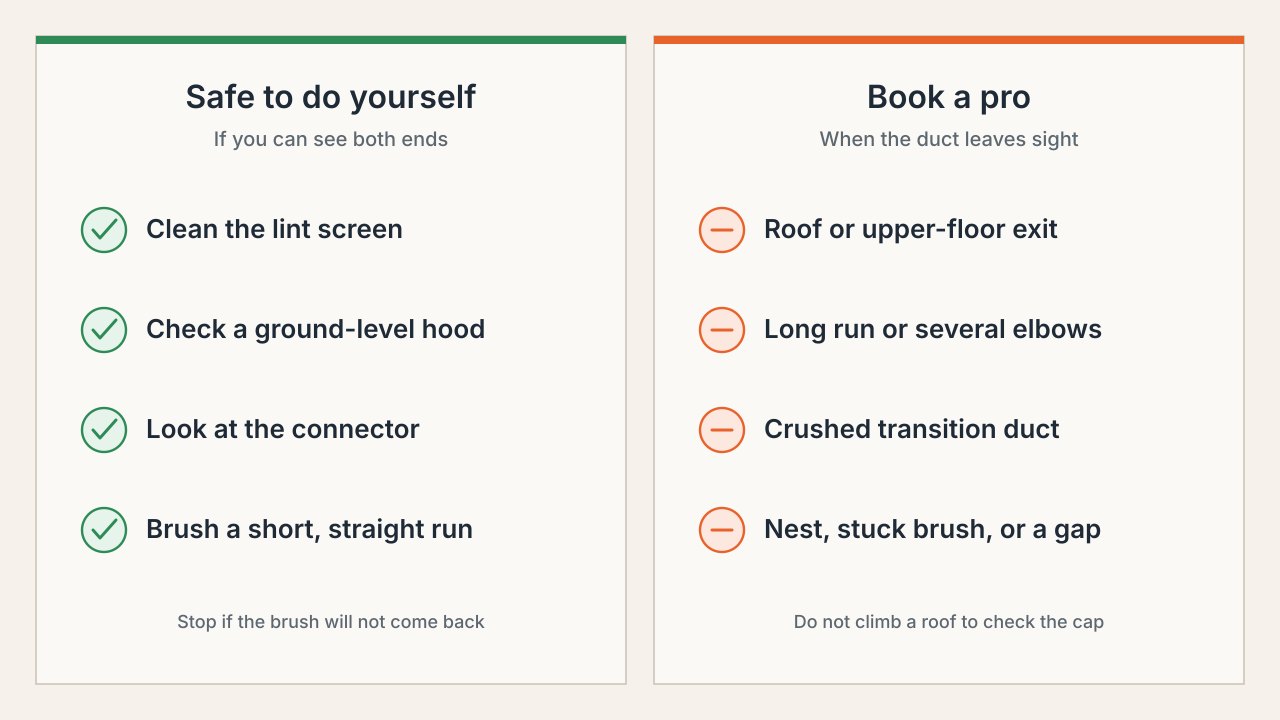
Book professional dryer vent cleaning when the run is long, the exit is on the roof or an upper floor, the connector is crushed, the hood has a nest, a brush has stuck, or you are not sure the duct is still one piece. Also book when a normal load needs two cycles, the top of the dryer is hot to the touch, or there is little air at a hood you can reach. Those signs are ranked in five signs your duct is packed. If the dryer runs hot, unplug it and leave it until the duct is cleared.
A visit works from both ends. The hood comes off and is cleaned by hand, the flap is checked, and the airflow is read before and after. You get photos of the duct. A kit on one end of a pipe you cannot see does none of that. If a section is damaged, the work stops and you are told, rather than a brush being forced through.
The published dryer vent cleaning cost is $129 for a standard ground or side-wall clean, with a run under about 15 feet, and $169 for a roof, upper-floor, or long run. You see which price applies before you book. After the first visit, the annual plan is $109 for the next standard clean if you stay enrolled. A new duct, cap, or dryer part is not in the flat rate. What the price includes is the full-run clean, a basic inspection, an airflow check, and photos.
The NFPA report says to clean lint out of the vent pipe once a year, and notes that lint removal services exist. A kit on a short, straight duct can be part of looking after that pipe. It is not a stand-in for the full run when the duct leaves the room and you cannot see where it ends.
Book
Fixed prices, real availability, book and pay online: Book a visit. Or call (720) 605-3198. Serving Boulder, Louisville, Lafayette, Longmont, Superior, and nearby Boulder County towns.
Recognise your laundry room in this?
Two taps for your price and a request for this week’s openings.